How to Protect Your Mental Health While Consuming News
Written By: Christine Chae, LCSW
The news never sleeps. Between push notifications, social feeds, and around-the-clock coverage, it is easier than ever to stay informed, and harder than ever to step away. For many people, what begins as a quick check-in turns into hours of scrolling through distressing headlines, a habit so common it has earned its own name: doomscrolling.
Staying engaged with the world matters, but not at the cost of your peace of mind. This article looks at how constant news affects the mind and body, how to spot when it is wearing you down, and how to build habits that keep you informed without leaving you overwhelmed.
How Constant News Affects the Mind and Body
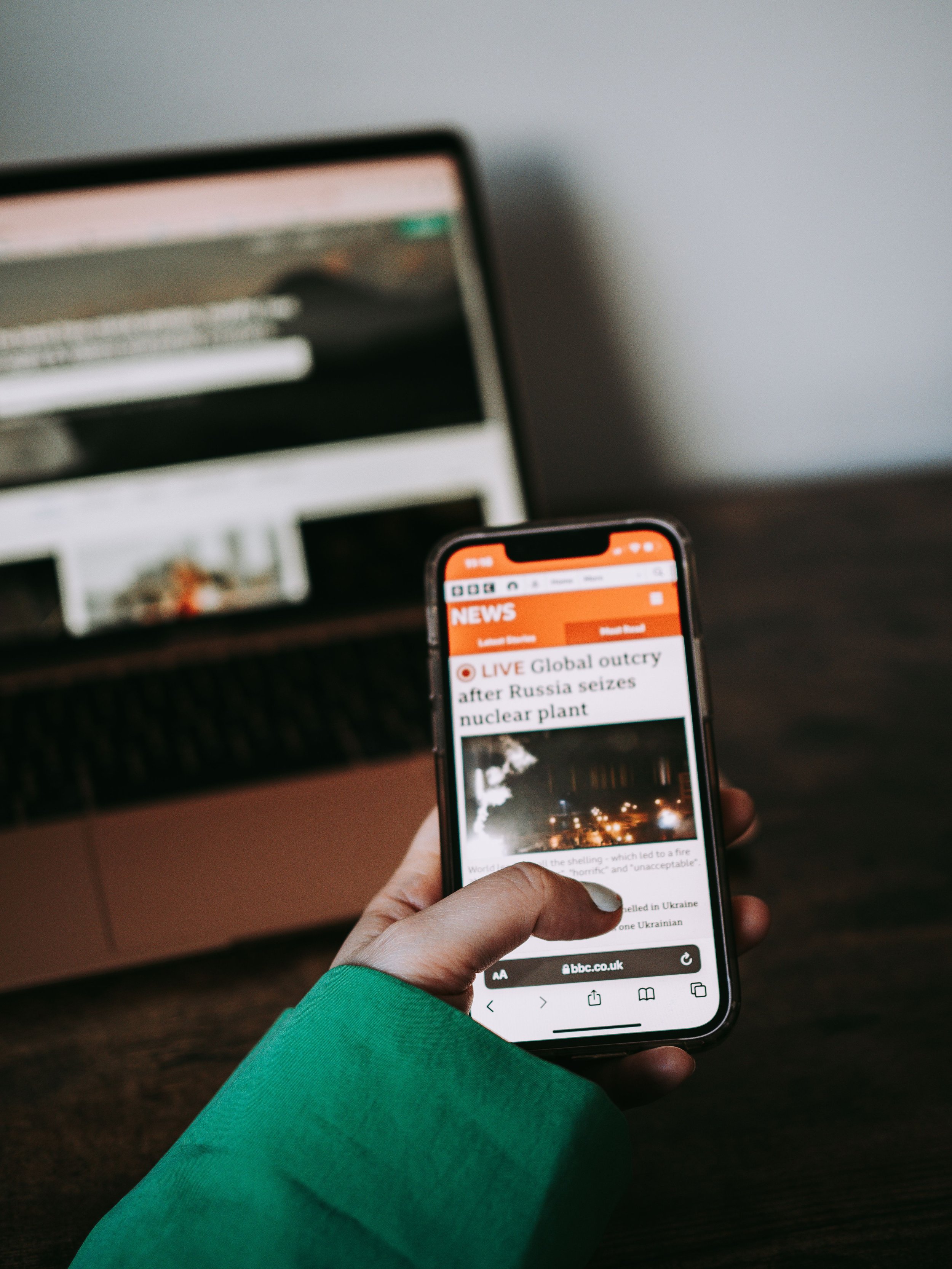
Our brains are wired to pay close attention to threats. That instinct once kept us safe, but in a world of endless alerts, it can keep the nervous system on high alert long after any real danger has passed. A steady diet of alarming headlines can keep the body's stress response switched on, flooding it with tension that has nowhere to go.
Over time, this low-grade activation takes a toll, from disrupted sleep to difficulty concentrating and a persistent sense of unease. Because so much news now arrives through phones and screens, the strain often overlaps with the broader impact of screen time on mental health, compounding the sense of being mentally maxed out.
Part of what makes news uniquely draining is that it often presents problems we cannot personally solve. We read about distant crises, complex conflicts, and looming uncertainties, and the brain registers each one as a threat that demands a response. Yet there is no action to take in the moment, so the worry simply accumulates. Add the design of many apps and feeds, which are built to keep us scrolling through an endless stream of updates, and it becomes clear why a quick glance can stretch into an hour that leaves us more depleted than informed.
It is also true that people differ in how much news they can comfortably take in. Someone who is naturally more sensitive, who is already managing a heavy load of stress, or who has lived through events similar to those in the headlines may feel the weight of coverage more acutely. There is no universal right amount of news to consume, and comparing yourself to others who seem unaffected is rarely helpful. The goal is to learn your own limits and honor them, treating your capacity as valuable information rather than a flaw to push past.
Signs the News Cycle Is Taking a Toll
Because checking the news feels normal and even responsible, it can be hard to notice when it has tipped into something harmful. Watching for the following signs can help you catch the shift before it drains you:
Compulsive Checking
Reaching for your phone to refresh headlines even when nothing has changed is a common red flag.
Rising Anxiety or Dread
Feeling a knot of worry after reading the news, especially about things outside your control, signals overload.
Sleep Disruption
Scrolling late at night or waking to immediately grab your phone can interfere with rest and recovery.
Irritability and Tension
A shorter temper or a constant sense of being on edge can trace back to media saturation.
Difficulty Focusing
When your attention keeps drifting back to the latest update, it can be hard to stay present with work or loved ones.
If several of these feel familiar, it is not a personal failing. It is a sign that your relationship with the news could use some gentle boundaries.
It can help to remember that these reactions are by design rather than weakness. Modern news and social platforms are engineered to capture and hold attention, often by emphasizing the alarming and the urgent. Recognizing this can take some of the self-blame out of the equation. You are not failing to cope with a normal amount of information. You are responding, like most people, to a stream that is far larger and more emotionally charged than the human mind evolved to process.
With that understanding, the path forward becomes less about willpower and more about thoughtful structure.
Setting Healthy Boundaries With the News
Protecting your mental health does not mean tuning out the world. It means deciding, on purpose, when and how the news enters your day. Boundaries give you back a sense of agency, which is itself a powerful antidote to the helplessness that distressing coverage can stir.
A good starting point is to notice that staying informed and staying glued to a feed are not the same thing. Learning to set boundaries as a form of self-care applies just as much to media as to relationships. It can also help to recognize how technology shapes our connections, since the same devices that deliver the news influence the impact of technology on relationships. Folding news limits into a broader plan, such as a self-care plan that works for you, helps the boundaries stick.
Boundaries also work best when they are realistic rather than absolute. Swearing off the news entirely often backfires, leaving people feeling disconnected and then bingeing to catch up. A gentler goal is to decide what role you want the news to play in your life and to shape your habits around that intention. You might let yourself stay informed about the issues you care about most while letting go of the pressure to track every developing story.
Permission to look away is not apathy. It is a way of preserving the energy you need to engage thoughtfully when it counts.
Practical Habits for Mindful News Consumption
With a little intention, you can stay informed in a way that supports rather than erodes your wellbeing. The following habits make news consumption a choice rather than a reflex:
1. Set Specific Check-in Times
Choose one or two windows a day to catch up on the news instead of grazing continuously. Bounded time gives your mind room to rest between updates.
2. Curate Your Sources
Favor a few trusted outlets over a flood of feeds and alerts. Quality reporting informs you without the relentless churn of sensational headlines.
3. Turn Off Nonessential Notifications
Silencing breaking-news pings puts you back in control of when you engage, rather than reacting to every buzz.
4. Pair News Time with a Grounding Practice
After reading, take a few minutes for a calming reset. Simple calming techniques to reduce anxiety can settle the nervous system before you move on with your day.
5. Build in Screen-free Buffers
Keep the first and last waking hours news-free to protect your sleep and your mornings. A short mindfulness meditation practice can fill that space with calm instead of cortisol.
Adopting even a couple of these habits can shift the news from a source of dread to a tool you use on your own terms.
Staying Engaged Without Burning Out
Caring about the world is a strength, not a weakness, and you do not have to choose between being informed and being well. The aim is sustainable engagement, the kind that lets you stay aware and take meaningful action without sacrificing your peace. Channeling concern into a small, concrete step, whether a donation, a conversation, or a vote, often eases the powerlessness that fuels news anxiety.
It also helps to balance heavy headlines with sources of perspective and hope. Following stories of people working toward solutions, talking through the news with someone you trust, and reminding yourself of what remains good and stable in your own life can keep difficult events from overwhelming your sense of the world.
Engagement that includes room for rest, connection, and meaning is the kind you can sustain for the long haul, rather than the kind that leaves you burned out within weeks.
Think of it like any other part of a healthy life. We do not nourish ourselves by eating constantly, and we do not stay strong by never resting.
The same balance applies to information. Taking in what you need, stepping away to digest it, and returning when you have the capacity is not avoidance. It is a sustainable rhythm that lets you stay both engaged and well over the years ahead.
If news-related stress has grown persistent and is affecting your daily life, working with a therapist can help you build lasting coping skills and address the underlying stress. For anxiety that feels hard to manage on your own, anxiety treatment in Los Angeles and flexible virtual counseling make support easy to access. At Abundance Therapy Center, with offices in Los Angeles and Riverside and acceptance of IEHP and Medi-Cal, you can reach out whenever you are ready.
Conclusion
The news will always be there, but your mental health deserves protection from its constant pull. By understanding how nonstop coverage affects you, noticing the warning signs, and building mindful habits, you can stay informed without feeling consumed. You can also lean on coping skills and professional support when you need it. Staying aware of the world and staying well are not opposites. With a few thoughtful boundaries, you can hold both.
Disclaimer: The information contained in this blog and website is for general informational and educational purposes only. It is not intended to be a substitute for professional medical advice, diagnosis or treatment. Always seek the advice of your physician or other qualified healthcare provider with any questions you may have regarding a medical condition. Read our full terms of use here. If you are having a mental health crisis, stop using this website and call 911 or 988. Click here for resources that can provide help immediately.